


The Rangers had lost 11 of 17, with a dreadful run differential that suggests they were lucky they hadn’t lost more. They were hours away from dropping a 12th of 18 to cap off an abysmal road trip against baseball’s two worst teams, when I headed over to see a couple old friends.
I was already looking forward to the visit. My baseball team saw to it that I pretty much couldn’t wait.
At the backyard gathering, I met a family of five.
Among them, a 10-year-old who couldn’t wait to ask me who my favorite Rangers players were.
And an eight-year-old excited to share that she volunteered this season to play the most challenging position on the diamond.
And a four-year-old excited because her brother and sister were so excited.
The thing that brought me to that house Sunday afternoon was the chance to catch up with a teacher and a buddy who’d had huge and lasting impacts on me in my elementary school days.
As it turns out, it was the three kids, Noah and Peyton and Skylar, who reminded me of those same days in ways I didn’t expect. Days when I grew to love the game that, at times, I have to remind myself I’d never want to live without.
I’m not sure I have any memories of my fourth year more vivid than getting that first chance, in those gaudy green-and-yellows, to get on the T-ball field with my like-minded friends.
Or, at age eight, the baseball cards and the Bat Nights and the 94-win Rangers in a sport that hadn’t yet adopted the NFL concept of the Wild Card.
Then, when I was 10, things ramped up.
I’ve written about it a number of times, in different contexts. It was at that age that the game started to change me in more meaningful ways — when I got to play for Ryan Prager’s grandfather Jerold:
What was new to me when I wore the Henry S. Miller red and then the Dallas Piping black, first as a 10-year-old player in 1979 and for five more years after that, was a level of confidence that served me well on the field. And just about everywhere else.
With all due respect to the other coaches I’ve played for, I had two in my life who had a massive impact on me, and not just as an athlete. Before Frank Shor (basketball), there was Jerold Prager. When Mom or Dad dropped me off at my first Coach Prager practice, I didn’t know him and I’m pretty sure, at that point, I didn’t know any of my new teammates, either, which was unsettling enough at that age. I quickly figured out Jerold was not the pep-talk type. He was demanding, easily frustrated, and business-like. It felt like he expected a lot. I mean, we were kids.
But I’ll never forget this: in the middle of a practice, one of the two or three we had before the North Dallas Chamber season got rolling, he came up to me and said I was going to play shortstop.
I’m sorry, what?
I didn’t dare say that out loud. I probably said nothing out loud. I knew I could throw pretty well for my age — and I cared a lot, which many years later I would recognize is a good box for a shortstop to check — but I was one of the smallest players on the team. Plus, Chamber teams were made up of double age groups. We were 10- and 11-year-olds, and I was one of the 10’s.
But this tough-nosed, no-nonsense coach I’d known only a week or two told me I was his shortstop. There was some level of fear, I’m sure, that fastened in a heightened focus for me in that moment. I didn’t want to disappoint him.
The truth is Coach Prager set expectations for me that were higher than those l’d allowed for myself, and I’m betting hundreds of others would say the same about him. I ended up being his shortstop all those years, and it was his belief in me that gave rise to a level of belief in myself that I suppose might have evolved some other way. Eventually. Maybe.
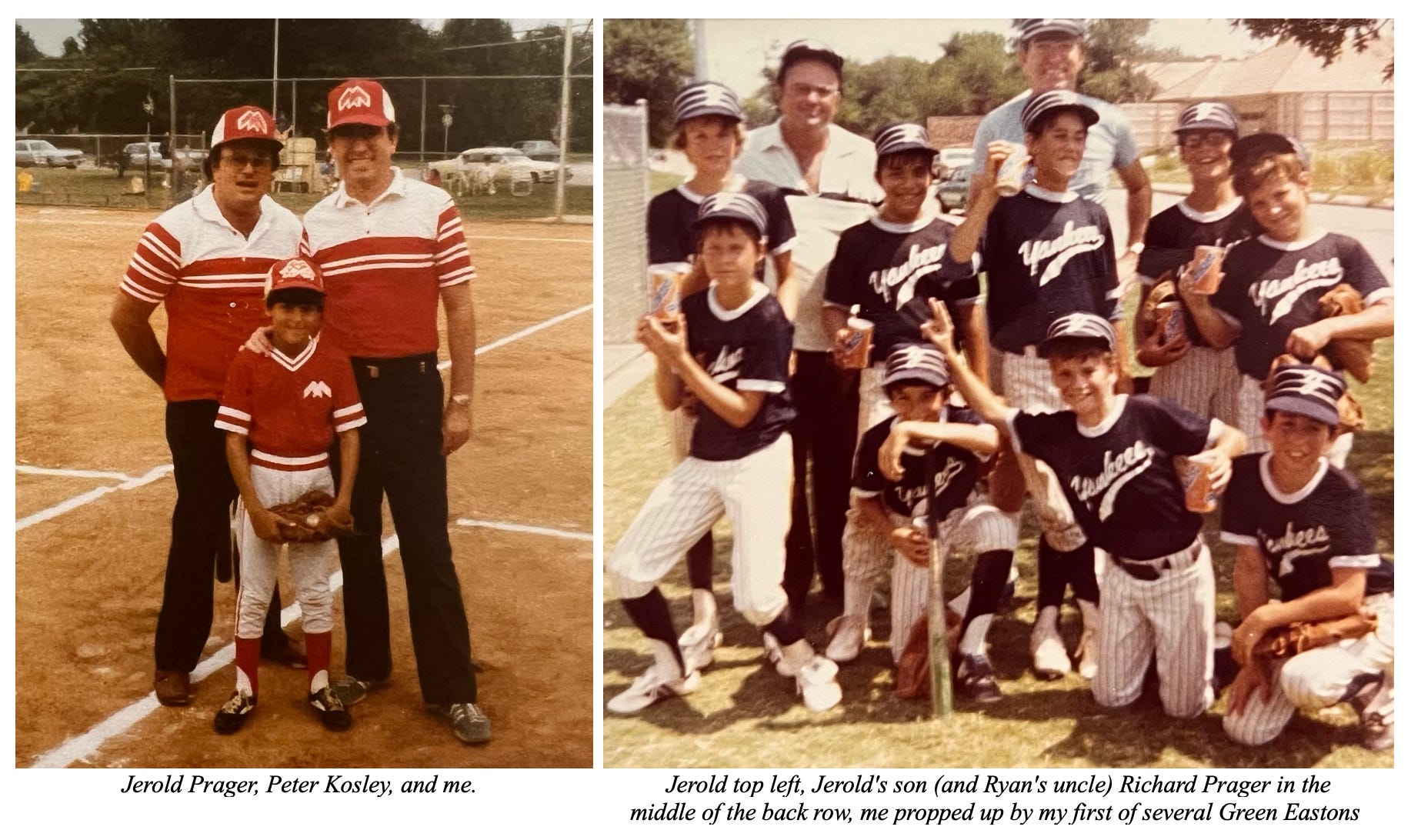
I got better at baseball playing on Jerold’s teams. I wanted the ball hit to me because he wanted the ball hit to me. I learned how to go with the pitch, how to work around the bag on a double play, how to steal signs. But I also learned what it meant to be a teammate. It was cultivated on those teams more than it was taught.
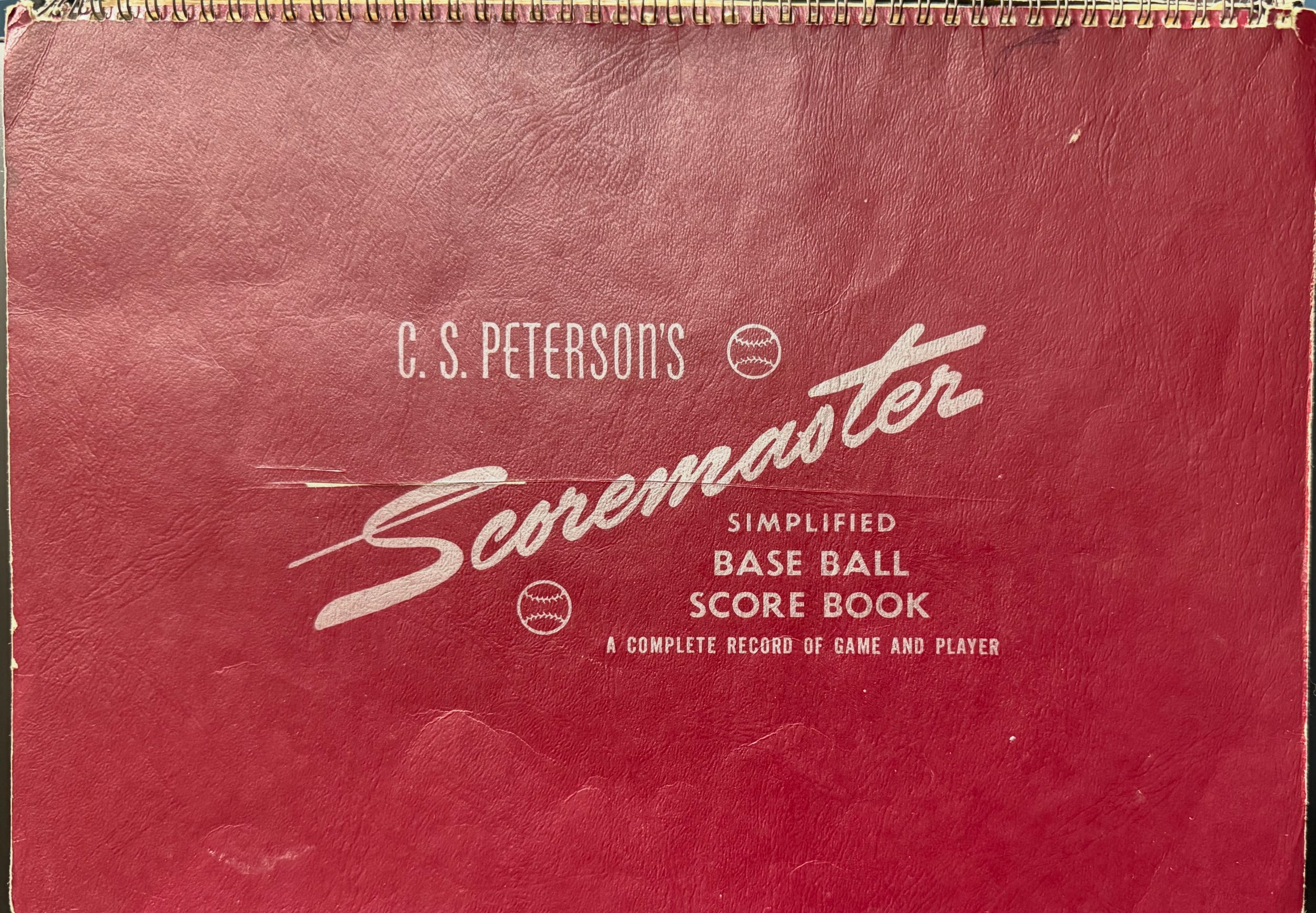
As I’m sure is the case for many of you, playing the game is what inspired me to think about the game — a lot — in ways that two or three televised Rangers games a month, and a trip or two a year to the Arlington Stadium bleachers, couldn’t have on their own. All those (not-gaudy) green-and-gray backs of the 2.5-by-3.5’s inside those Topps wax packs helped, along with the weekly Sporting News and yearly Street & Smith’s. So did the nightly radio broadcasts, many chronicled in my trusty Scoremaster.
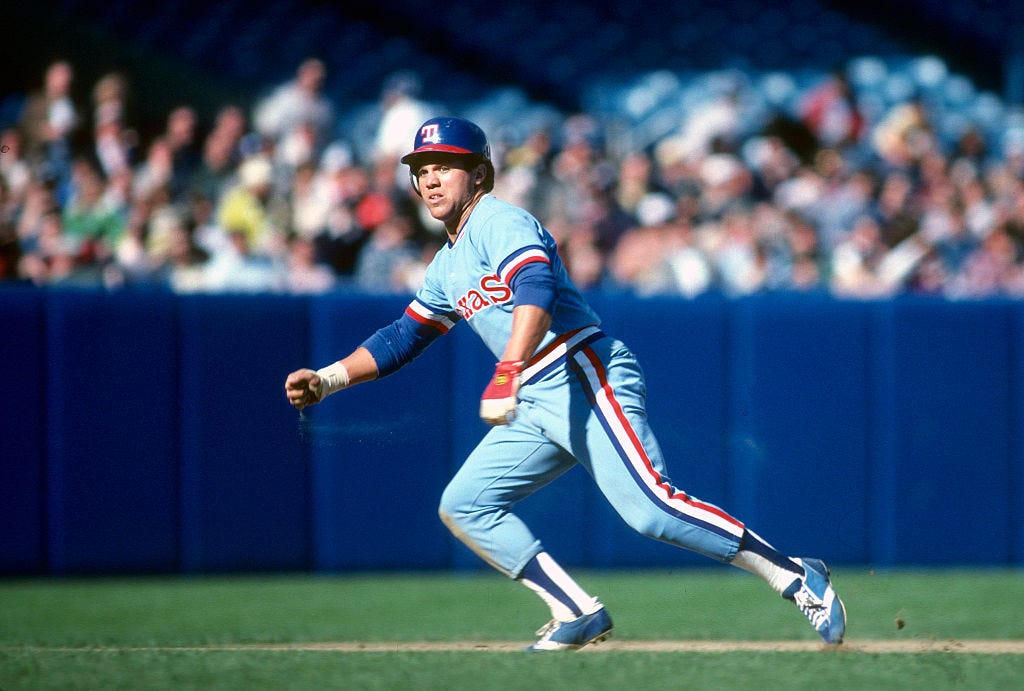
But there was nothing like working at the game and competing. I wanted to start 6-4-3’s like Yount to Molitor. Get a Bump Wills jump and swipe a bag. Bats left; throws right; George Brett.
Seeing Bert Campaneris or Toby Harrah dive, backhand side? Can’t wait for practice.
Those, of course, were the Sisyphus years as a baseball fan. Just as football in the late ’70s meant playoff games around here, if not championships, baseball was, locally, a 162-chapter book. Without fail.
But I still had the look in my eye as a Rangers fan at age 10 that Noah had on Sunday.
Noah, of course, has also experienced as many World Series titles as I have.
Maybe that’s part of what’s made these last three seasons so challenging for me — and why the excitement he had talking about Texas Rangers baseball that afternoon, all things considered, felt a little incongruous.
Unless the incongruity was my own.
For various reasons, I’ve been to more Rangers games this year than normal. For a fan like me, they don’t matter, in the most basic sense, any more than your round of golf or binge-watching marathon does. Still, ballgames are a dependable distraction for me, something to get lost in. A healthy way (I think; I hope) to tap into a wide range of emotions for a few hours that I can then walk away from and get on with my life, or at least my day.
That I’m on a personal four-game win streak — two shutouts, a walk-off win, and Kumar Rocker soundly outdueling Seattle’s George Kirby — doesn’t change the fact that it’s been a demanding, often draining season, in spite of more summer days holding down a playoff spot than not.
At my advancing age, I probably reflect on these things more than I did when I was in my early 40s when World Series were lost, or in my late 20s when I started writing about the game — let alone when I was Noah’s, Peyton’s, and Skylar’s ages. Maybe the effect of yet another center-cut fastball taken for strike three, an outfield that gets run on with abandon and impunity, the bases loaded with one out and then with three, or an especially bad road trip is exacerbated because I’m relying on baseball to take my mind off of life stuff for a chunk of the day, and it doesn’t always cooperate.
It’s been a year in which that cooperation has essentially been a coin flip.
The last hurrahs of my life in the game, at least between the lines, went down unceremoniously in the late ’80s, in two separate weeks at Disch-Falk Field with one day at Southwestern University in between. The idea that baseball would end up as a through-line in my adult life as well, through writing and, to an extent, lawyering and teaching as well, would have been silly back then to have counted on, or even dreamed up.
But I trust, even without those things, I’d still be watching every Texas Rangers game I could, and getting out to the ballpark consistently. Because I love it. And also because I need it.
After an adolescence caring a whole lot about the baseball games I got to play in, I’ve spent an unreasonable amount of my life caring about ballgames played by other people. I accept the arrangement. They play. I watch. Occasionally, I write about what I watch, which, if I step back from all of this, is arguably an even more questionable use of my time.
But it’s been good for me. It matters deeply to me. Rangers wins and Rangers losses usher in highs and lows that I hold sacred. While I no longer let them define me day to day like they once might have, I do think they make the things that do define me more enjoyable on one end of the spectrum, and maybe easier to weather on the other.
So why has 2026 — with a second postseason berth in a decade legitimately there for the taking — tested all of that more than most? It’s not as if stretches of losing baseball are unfamiliar territory. It took me 20 years of paying attention to this team to experience a playoff game. Fourteen more years before Texas won a playoff series. Thirteen more after that until the parade — which has been bracketed to date by six seasons on one end and nearly three on the other without a playoff game or even a single winning record.
Sadly, but factually, losing has been part of the franchise’s short- and very-long-term story.
But there’s a special brand of difficulty in watching a team when you’ve experienced what the other version feels like. I’ve said it a hundred times, and thought it a thousand: thank goodness the Rangers closed the deal in Arizona on November 1 three years ago. A loss that night would have meant a Game 6 against Merrill Kelly — who had shut Texas down in Game 2 — and then some sort of mix-and-match affair in a Game 7, since Max Scherzer had been dropped from the roster with a back injury he suffered in Game 3.
Had the Rangers not won the 2023 World Series, I can’t imagine how agonizing 2024 and 2025 would have been, and how I’d be handling 2026. “Not well” is probably a strong guess.
But there’s the other side of that. Once you’ve watched the Rangers win the last game there is to win, once the dogpile is no longer an abstract vision, once you’ve experienced all those people in the uniform you have always identified with finally get the thing that had always belonged to somebody else, baseball changes a little.
I’m pretty sure I expected less sports-suffering after 2023. Or maybe that the suffering would bother me less.
I might have been wrong about that.
So I’ve found myself thinking, through a 2026 season that, for all it still could be, has been such a slog, about why any of this still has such a hold on me. Why does it still rattle in my bones when the Rangers leave the bases loaded? When a pitcher remembers too late he’s supposed to cover first base? When two-thirds of the team’s baserunners are no threat to seek out 90 more feet than the batter?
David Moore’s eulogy of former Mavs coach Don Nelson for D Magazine this month included this:
I think we can all agree that the American League standings check the hope-and-excitement box for Rangers fans.
The style of play, not so much.
But why do I allow all these grain-of-sand moments over 162 nights of them to drain my life force — at least until the next afternoon, when I’m pulling up that night’s lineup? The year’s book almost always ends disappointingly, one way or another. Statistically, I suppose you should be OK winning the final game only once every 30 years — but for a franchise with this history, seizing it once in a lifetime, even if it took the month-long heater of all heaters to do so, felt like everything. So why, with that championship in the bag, do I let bad baseball, even when mixed in with nearly as much good, pummel me and grate my nerves and try my patience the way it does?
On Sunday, I asked Noah how he felt when the Rangers won it all. I guess he was seven years old back then, maybe eight.
You’d have understood his answer even if you’d muted the audio. The look on his face was enough.
I asked because I wasn’t sure how I was going to feel when that day — if that day — ever arrived. As it turns out, it wasn’t what I expected it would be. Hours after my reaction was caught on video, I sat down to write about the night, through five or six complete re-airings of the MLB Network postgame show, until the sun came back up:
Nostalgia is a powerful thing. So are scars. The Rangers, whose 52 seasons include 48 that I’ve cared deeply about, have hit me in all the feels. They’ve broken my heart, and done so at a level it’s hard to imagine hurting more. They’ve also given me so much joy, but for the first 51 of those seasons, never the ultimate version.
Not until Game 5 of the 2023 World Series: Texas 5, Arizona 0.
* * *
It no longer mattered that the Rangers lost Jacob deGrom after six starts, and Adolis Garcia and Max Scherzer during the World Series. Or that they didn’t add enough winning bullpen pieces before the season, or in July, and blew more saves than they recorded. Or that they lost 94 games a year ago. Or that they lost 16 of 20 late this season and plummeted not only out of the division lead but also out of one of the six playoff spots.
It no longer mattered that they’d been stymied by Zac Gallen for the first six innings of the game and then couldn’t get a runner in from third with no outs in the seventh and with one out in the eighth and with no outs in the ninth.
It no longer mattered that [Aroldis] Chapman once again couldn’t finish his inning or that [Josh] Sborz hadn’t thrown 2 1/3 innings since he was a Double-A starter in 2017.
None of it mattered. Sborz punched out four of the eight batters he faced, including Geraldo Perdomo to start the ninth and Ketel Marte to end it. He spiked his glove, and his teammates all rushed him at the mound.
And I stood completely still.
* * *
It’s been a very emotional year for me. I lost my dad. Our kids have moved on from the house and are charting their own paths. World events have been heartbreaking.
Over the years, I’d gotten much better at avoiding getting too high or too low. Sports setbacks in particular stopped hitting me quite as hard. Maybe it was a matter of maturing out of needless mood swings. Maybe it was just experience, and no longer overreacting to things I’d been through before.
But this was new. As the visitors’ dugout emptied in a sprint and the bullpen did the same, my heartbeat slowed. I cried. In that amazing, overwhelming, unfamiliar moment, I had no clue how I was supposed to feel.
Zero.
* * *
I’ve been waiting for this peculiar, powerful, ineffable feeling my entire life. For the last eight hours, I haven’t wanted to put any expectations on what shape or depth that feeling might take. I’m not going to force the action. No song lyrics to wrap around the moment, no historical reference points, no attempt at description or category.
I don’t want to put this feeling — this acceptance that the Texas Rangers have, in fact, won a World Series championship — in any sort of neatly identifiable box. You’ll just have to understand that I have zero intentions of doing that, and that this is, at long last, a game that I happily plan to let come to me.
To prepare to write this story, I went back to re-read that one. To summon up that feeling that now seems twice as distant as it actually is.
This one:
I read that story and I watched that clip . . . and it made me think to go find another piece I’d written, 54 days earlier, on September 8.
Three and a half weeks before that one, the Rangers were 3.5 games up in the West. They’d traded for Scherzer and Chapman and Jordan Montgomery. I was blocking October off at work.
Then Texas proceeded to drop eight straight, spitting up the division lead in just over a week. After winning three of four, the losing started up again: seven of eight, with the lone win a walkoff in a game that saw the Rangers squander three different leads. It was before the final loss in that stretch — an ugly one at home to the awful A’s — that I wrote.
The story’s title: “The Rangers Aren’t Done Yet. Neither Am I.”
Perhaps the title tells you all you need to know. But here’s an excerpt:
In that game, the Astros became the first team in baseball history to stack up 50 hits and 16 home runs in a three-game series, not to mention the first to score at least 12 runs with at least five homers in three straight games. In one of the biggest series in Rangers history.
On August 15, just before the 15-losses-in-19-games skid started, the Rangers were 72-48 (a robust .600 winning percentage three quarters through the season) and had a 95.1 percent chance of making the playoffs for the first time in seven years. After the Houston series, the number stands at 51.1 percent.
Every season, fan bases for 29 teams walk away disappointed on some level. And still, at this moment, I stand by my insistence that a sports gut punch, no matter how seismic, beats irrelevance. I’ve been tested these last three weeks. Not only has this stretch been packed full of early-inning blowouts and late-inning meltdowns — there have been very few “normal” losses — but even the victories have been taxing. Of the four wins the Rangers have earned in these last 19 games, three were by one run and the other was tied going into the ninth. (One of those one-run victories marked the only time all season the Rangers won when trailing after eight innings.) I’ve been tested. But I’m still upright.
A sports gut punch, no matter how seismic, beats irrelevance.
The next three weeks, you might recall, were as excruciating as they were hard to believe. Six straight wins. Four straight losses. Six consecutive wins. Then the Rangers lost four of their final six games, fumbling the division lead they’d owned for nine straight days, only to surrender it in Game 162 when they managed to send three batters over the minimum to the plate in a 1-0 loss in Seattle. A 2,500-mile flight to Tampa, instead of a bye, was the result.
Four weeks later, the Rangers gave us the thing so many of us had waited a lifetime for. Along the way: sweeps of the top two teams in the AL, an 11-0 road record, and a Corey Seager mic drop.
I can say this with the benefit of perspective: All that suffering over the final six weeks of the regular season — all those gut punches — turned out to be so much more than a punishing prelude to the ultimate payoff. It was part of the payoff — six harrowing weeks layered onto 51 trying seasons, all of it giving greater weight to what happened next.
It was perfect.
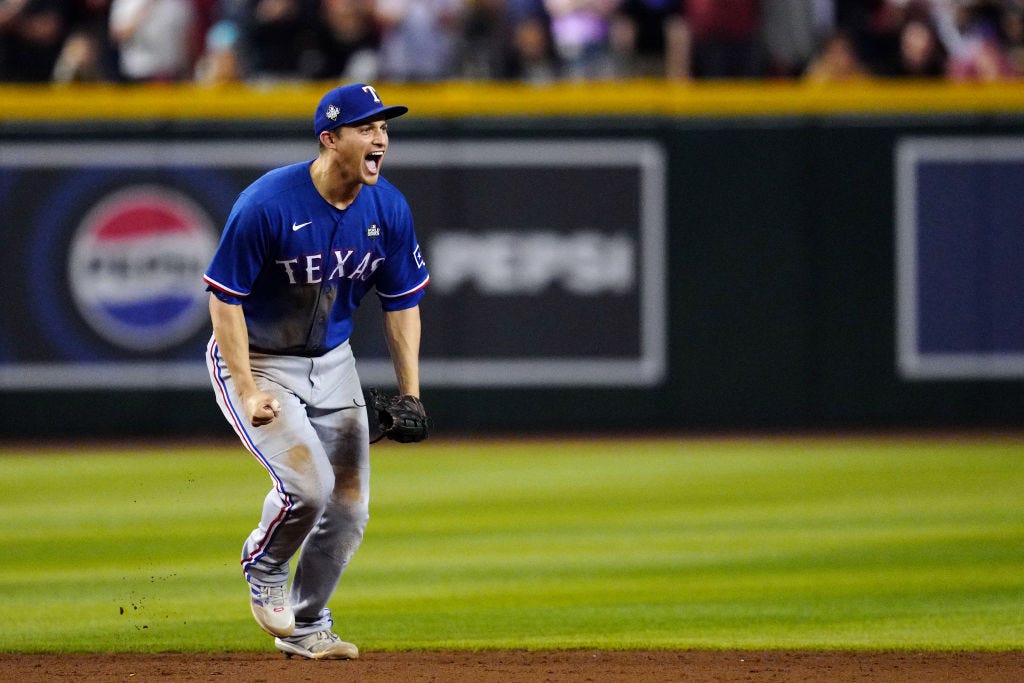
Maybe that’s the bargain. The payoff just isn’t the same without exposing yourself to all the bruising disappointments that come before it. Caring enough for the good to feel that good means caring enough that the bad is going to hurt.
I’ve spent a fair amount of time this season asking myself why I still willingly sign up for both.
Come to think of it, some version of that question has been rattling around in my head, some Rangers seasons more than others, for 50 years.
I just wasn’t always asking the question about myself.
A little more than six months before the Rangers scaled the mountain in Phoenix, my Dad passed away. I wrote about him then, and told a story that I’ve probably referenced three or four times over the 28 years I’ve been writing about the team:
Among my earliest memories are the every-Saturday trips with Dad to the Schepps convenience store at Midway and 635 for something out of the ice cream freezer. In 1976, at my suggestion, that ritual changed to a weekly pack of Topps. Baseball in the spring. Football in the fall. Cardboard gum bricks all year.
Dad didn’t collect cards. He wasn’t a star athlete. We didn’t go to games unless someone else invited us to tag along. But we never missed the Cowboys on TV, preseason through playoffs, and it was almost always with another family or two, along with tons of food. A reliable blast—and it didn’t hurt that the Cowboys were great in the mid-’70s.
That didn’t prevent Dad — and Mike, or Joe, or Harrell, or whoever we were watching the game with that weekend — from coming unglued if Efren Herrera shanked one wide right or Bob Breunig failed to wrap up the ball carrier on what turned into a 40-yard house call.
“Dad, c’mon,” I’d plead, not interested in deflating the fun. “He didn’t try to miss that tackle.”
But even if I didn’t realize it, I was learning a behavior. And a passion.
My final, futile objection to the intensity, with all its highs and lows, that Dad watched football with was lodged on one of those Saturdays as we pulled into Schepps. I remember this moment like it was Robert Newhouse taking the pitch left and winging a perfect 30-yard dime to Golden Richards for six.
“Dad, how many of the Cowboys do you know?” I asked, excited for whatever the answer was going to be.
“Personally?”
Yep.
“None.”
Wait, what?
“Then why do you care so much if they win?”
I remember the parking space we were in, but I don’t remember his answer to that question. I’m pretty sure, though, that it informed, inspired, authorized a new way that I was about to start clothing myself in sports. Investing that much intensity into sports — competing, training, watching, collecting, debating, caring — was OK. Because Dad did it.
As I said in my eulogy, in his final month, Dad asked me on every visit how the Rangers had done the night before. If it were football season, it’s a question he might have asked his caretakers. But even though baseball wasn’t his favorite sport, it was one of his favorite subjects with me. It was sports, after all — a gift he’d given me, a thing I learned to love by seeing him love it. A thing we shared. I fully believe Dad religiously asked last month if the Rangers had won because he knew if they did, that meant my own day was a little better. And that made it a good day for Dad.
* * *
Baseball was mine. But first, sports were Dad’s and mine.
Maybe it’s just Dad’s words I don’t remember. Maybe I absorbed the answer anyway.
Soon after the World Series parade, my editor at D Magazine, Mike Piellucci, asked me to describe the feeling I’d had the moment that Sborz dropped in That Curve. My response:
Watching the video brings it all back . . . . I thought about the team that has occupied increasingly large plots of real estate in my soul for about 47 of my 54 years, dealing different pockets of joy and plenty of sports heartbreak, too. I thought about how everything changed, in that instant, for the architects and stewards of that team, the players who were on the field and those who were looking on in retirement. I thought about Dad.
It all added up to a moment of silence, basically. I was overcome.
When the Rangers win another championship, I’m sure my visceral reaction in the moment will be different. It can’t not be.
I’m fully invested in finding out.
Maybe what I’m most invested in, though, is holding onto the part of me capable of caring that much.
Which brings me to something I wrote 10 years ago, long before I knew what winning that first title would actually feel like.
The story was inspired by accident. I’d taken Max and his friends to a baseball card show, a world I’d walked into 100 times myself 30 or 40 years earlier but, this time, one I tried to experience through the eyes of a squad of 11-year-olds. In it I wrote:
I wasn’t a kid anymore in 1990. But I felt like one when I saw Ivan Rodriguez for the first time, separated by nothing more than a chain-link fence.
Baseball, like nothing else, has the power to make me feel like a kid again.
The daily adrenaline of the ups and the downs. The innocence of the game, and the complexity. The new hope it offers every day.
And every year.
Baseball is what, for lots of us, packs the promise that we’re going to paint our tails off, like a child, when that World Series is won.
When.
Not if.
When.
The “painting” reference came from an 80-year-old quote that’s been attributed to Pablo Picasso, but that I’d just heard for the first time days before that card show:
It took me four years to paint like Raphael — but a lifetime to paint like a child.
I think I had one of those moments on Sunday. It was that baseball back-and-forth with Noah. His is simply an uncomplicated love for the Rangers. It reminded me — maybe even blindsided me — just how much that 1970s kid is still in me, even if it’s buried sometimes.
That capacity to be irrationally thrilled and inordinately disappointed by baseball is a surviving piece of my childhood that I’d prefer adulthood — or a World Series championship — not wash away.
I was there on Sunday to reconnect with my favorite teacher.
But it turns out it was her grandson I think I learned the most from that day.
This story has my mind rolling through the years. I didn’t grow up playing or watching baseball. It was my son who loved playing the game that caused me to love watching the game. Years of little league and then travel ball. When he told me he didn’t want to play in college I supported him whole heartedly while at the same time knowing a part of me was gone. Five, six, even seven days a week in the truck driving to practices and games, talking and dreaming and laughing and crying, it was over. Yet, the Rangers remained. I got in a season ticket group when he was young so we could take friends and watch baseball when he wasn’t playing baseball. This will be my last year as a season ticket holder but not my last as a fan. While I can’t keep paying to watch seasons this dismal, I will still be watching. Maybe if 2023 hadn’t happened this year or last year wouldn’t bother me as much. But it did happen and it was glorious and I want more of it.
I learned to love baseball through my son’s eyes and heart and every game I watch reminds me of that joy I had watching him. It’s special every time.
Even at 61 years old and a love of the Rangers that began at age 7. I can relate to this story in so many ways.
But simply...
If the Rangers win, I goto bed a little happier. If they lose. I goto bed a little more sad.
Why? Because I am a fan.